MEI LAB
The MEI Lab develops delivery technologies that enable modern therapeutics—including RNA medicines, gene therapies, biologics, and immune cell–based treatments—to act safely, precisely, and effectively in the body.
Our research integrates pharmaceutical science, biomaterials, and chemical and biomolecular engineering to design delivery systems that overcome biological barriers and immune constraints. By studying how delivery materials interact with tissues, cells, and immune pathways, we develop predictable and translatable strategies to improve therapeutic performance and safety.
Who We Are?
The MEI Lab 1.0 was originally established in August 2022 at Binghamton University-SUNY, New York. We relocated to Salt Lake City, Utah, in July 2025 as MEI Lab 2.0.
We are part of the scientific discipline of Molecular Pharmaceutics, which sits at the interface of pharmaceutical science, biomedical engineering, and translational medicine. Molecular Pharmaceutics addresses a central question:
How can therapeutic molecules—and the systems that deliver them—be engineered to function at the right site, at the right time, and with the intended biological effect?
Our Approach
Many of today’s most promising therapies—such as mRNA medicines, gene-editing technologies, biologics, and engineered immune cells—are limited not by their intrinsic activity, but by delivery challenges. These modalities require protection, targeting, controlled biodistribution, and compatibility with immune and cellular processes to function safely and effectively.
In the MEI Lab, we investigate how biomaterials, polymeric and lipid nanoparticles, and molecular engineering strategies can be used to improve the specificity, durability, and safety of advanced therapeutics. By understanding how biological barriers, immune signaling pathways, and intracellular processes influence treatment outcomes, we engineer delivery systems that operate in a predictable and controllable manner.
Research Focus
Enabling Safe and Durable Gene Therapy for Rare Diseases via Immunoengineering
Gene therapy holds great promise, but its success depends on getting a therapeutic gene to the right cells, in the right amount, at the right time. We design delivery systems that improve targeting and safety, addressing one of the field's most significant challenges: achieving reliable, tissue- and cell-specific gene delivery. Our diseases of interest include DMD, ALS, Huntington's disease, and Hunter’s disease, etc. One of the key challenges in gene therapy for rare diseases is the adverse immunogenic responses to viral-based gene delivery vectors, which we’re currently developing biotherapeutic interventions to modulate. Our lab also works on developing non-viral gene delivery systems to enable gene therapy without adverse immunogenicity responses.
Transforming Cancer Immunotherapy
We aim to develop delivery platforms and therapeutic immune cells that make cancer immunotherapies more effective, more precise, and less toxic. By improving the delivery of immune-modulating molecules to solid tumors and immune cells, we aim to enhance anti-tumor responses while reducing unwanted side effects. Our primary focus includes breast cancer, colon cancer, and melanoma treatments.
Mapping the Spatial Immune Microenvironment to Enable Precision Therapeutic Delivery
Therapeutic delivery is governed not only by molecular design and target cell identity, but by the spatial organization of immune and stromal cells within tissues. Spatial immune architecture influences therapeutic access, antigen handling, intracellular trafficking, and immune programming across diverse disease contexts. Our lab investigates how biomaterials, lipid nanoparticles, and gene delivery systems interact with tissue-specific immune microenvironments in both malignant and non-malignant settings.
By combining spatially resolved immune profiling with delivery-driven perturbation studies, we define how distinct immune niches shape therapeutic efficacy, durability, and safety. These insights enable the rational engineering of delivery platforms that are not only cell-selective, but spatially and contextually programmed to achieve precise immune engagement while minimizing off-target inflammation and immunogenicity.
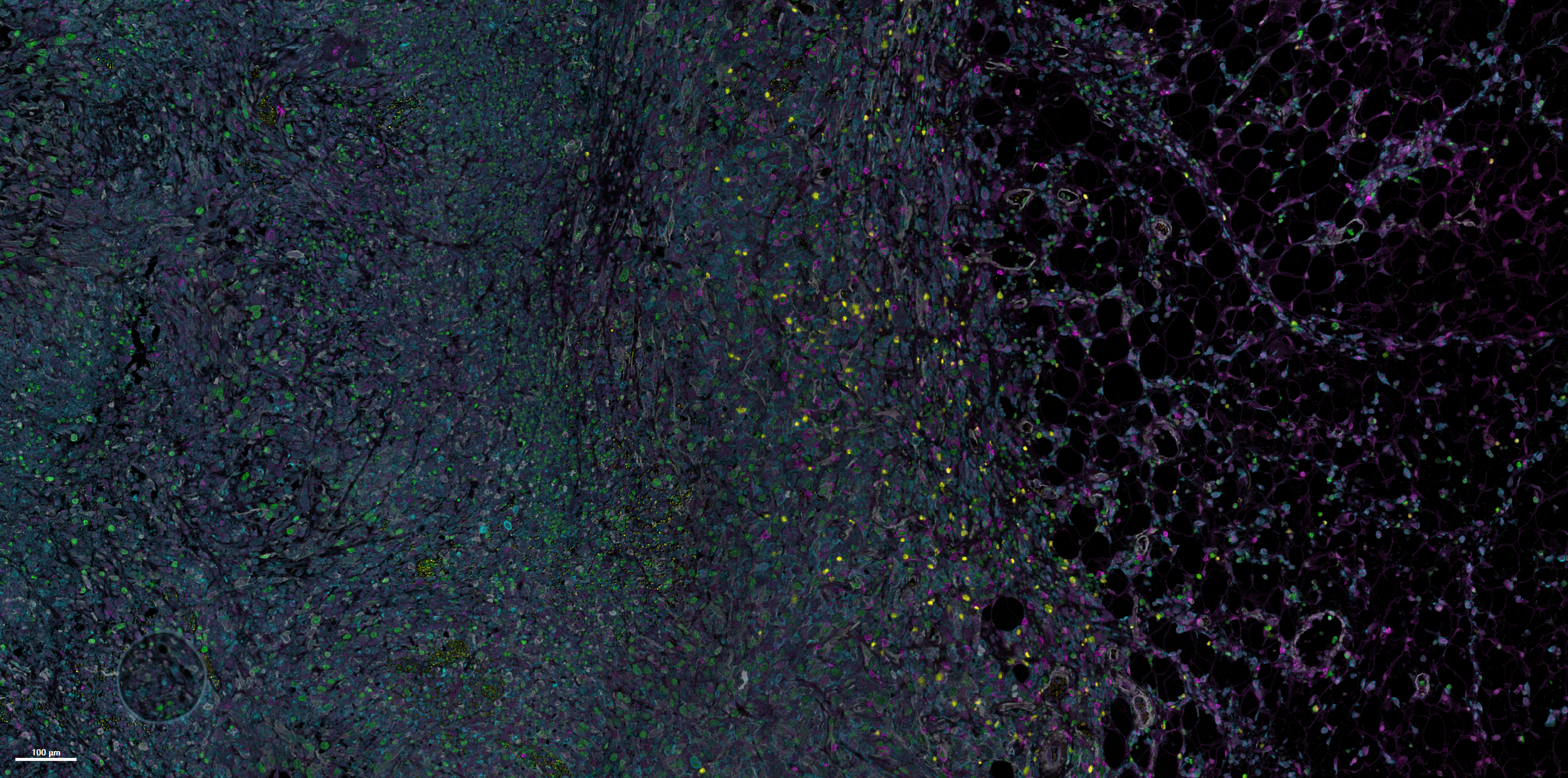
Solid Tumor is More Than Just Cancer Cells: Shown here is spatial immune profiling of a solid tumor, with each cell type colored differently. Yellow Cells = Regulatory T cells (Tregs). Source/Credit: MEI Lab - all rights reserved.